Archive for History

image_pdfimage_print

Wine-Cup Immortal

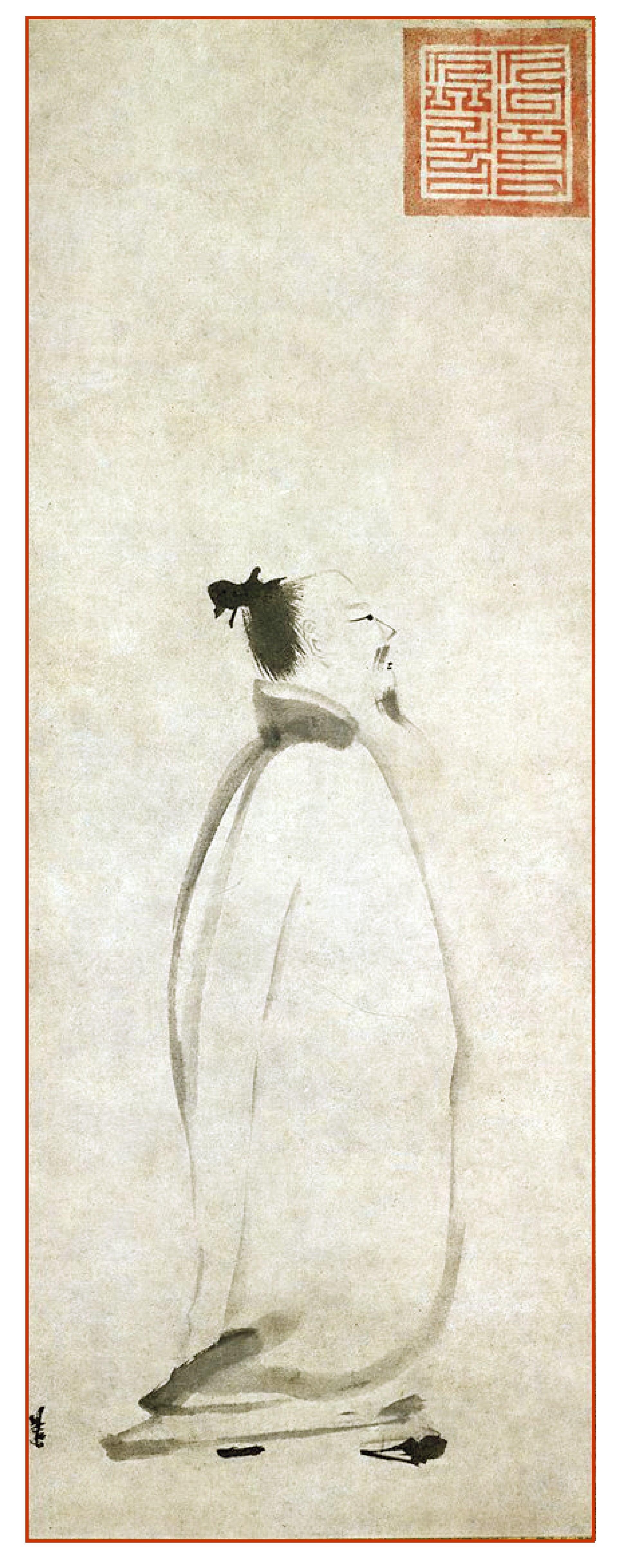
li bai portrait tokyoLi Bai (701-762 CE), also known as Li Po, was one of the famous Tang dynasty poets who called themselves the Eight Immortals of the Wine Cup (an irreverent allusion to the Eight Immortals of Taoism). Li Bai wrote prolifically, and over 1000 of his poems survive. Much of his life is mythical, the stuff of novels rather than of history (Elegant, 1997). He was a devotee of Taoism, a fine swordsman, and a great lover of wine. In his youth he served the emperor. After becoming involved in one of the rebellions, however, he was exiled from the court. He then spent much of his later life wandering “beyond the gorges” in the hinterland of Imperial China. Legend has it that he died drunkenly trying to embrace the moon’s reflection in the Yangtze River, but his death was perhaps a suicide. The illustrated portrait (from the Tokyo National Museum) was painted by Liang Kai in the early 13th century. The seal in the upper right corner signals that the painting was owned by Anigo, an important official in the Imperial court of the Yuan dynasty.

Appreciating Chinese poetry requires seeing as well as hearing. The beauty of the calligraphy is as important to the poetry as the music of the words. The poems are therefore difficult to assess without some feeling for the characters in which they are written, since these allude to meanings beyond those directly expressed by the spoken words. This post therefore begins with a few notes on Chinese characters.

Read more

Journey of the Magi

A blog for the season. One of the most vivid and intriguing Christmas stories concerns the visit of the Magi from the East:

Now when Jesus was born in Bethlehem of Judaea in the days of Herod the king, behold, there came wise men from the east to Jerusalem,
Saying, Where is he that is born King of the Jews? for we have seen his star in the east, and are come to worship him. (Matthew 2: 1-2)

In 1461 Benozzo Gozzoli completed a sequence of frescos depicting the Journey of the Magi for the Palazzo Medici Riccardi in Florence. Illustrated below is the first of these paintings. A crowd of important people follow the Magi toward Bethlehem. At their head can be recognized the great lords of Florence, Sforza and Rimini. Among the crowd are diplomats and scholars from the Byzantine Empire (see previous blog). Indeed, one of the Magi is thought to represent the Emperor John VII Palaeologus. The painting commemorates the Council of Florence (1439), when representatives of the Eastern and Roman Churches had met in an unsuccessful attempt to reconcile their doctrinal differences. The Byzantine visitors were probably as exotic to the Italians of the 15th century as the Magi were to the Jews of the first.

Read more

Late Byzantine

The Byzantine Empire began with the founding of the city of Constantinople by the Emperor Constantine the Great in 330 CE. By the 12th century Constantinople was the largest and richest city in Europe. Byzantium maintained its glory until the sacking of of the city by the forces of the Fourth Crusade in 1204 CE. After this the Byzantine Empire existed only in fragments. The Ottoman conquest of the Constantinople in 1453 CE ended the empire, replacing Eastern Christianity with Islam.

The art and architecture of the Byzantine Empire is justly famous. Buildings such as the Hagia Sophia taught the world the use of space; the mosaics of Ravenna, Venice and Palermo gave the Christian religion its iconography. This is the Byzantium of Yeats’ poem Sailing to Byzantium (1927)

O sages standing in God’s holy fire
As in the gold mosaic of a wall,
Come from the holy fire, perne in a gyre
And be the singing-masters of my soul.

Read more

Versions of History

On August 22, 1938, the Nazi government revoked the permits allowing Polish Jews to live in Germany. Between September 27 and 29, 12,000 Jews were deprived of their possessions, transported to the Polish border, and left there without food or shelter. Polish officials allowed them across the border, even though many no longer possessed Polish papers. The Jews were housed in makeshift accommodation in the town of Zbaszyn. They were hungry and desperate.

Among the expelled Jews was the Grynszpan family from Hannover. Esther Grynszpan sent a postcard asking for help to her 17-year-old brother Herschel, who was staying illegally with relatives in Paris. Herschel received his sister’s postcard on November 3. On November 6 he tried to convince his uncle to send money to Poland to help his family. A violent argument developed, and Herschel stormed out into the night.

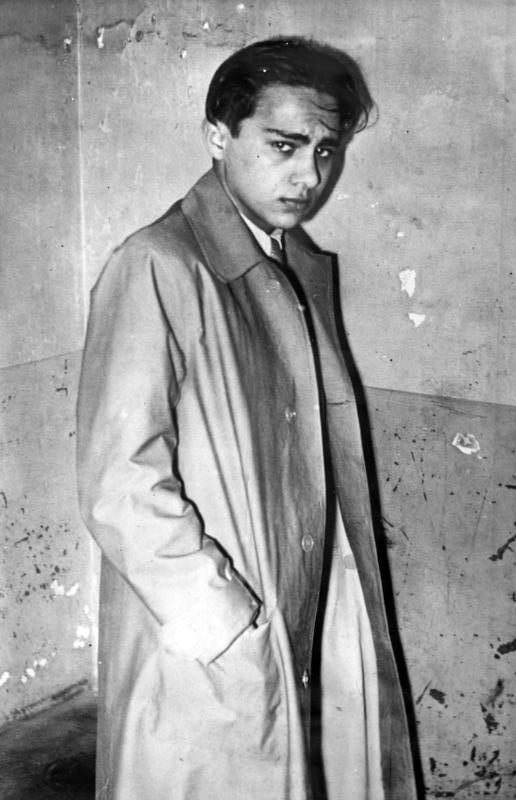
The next morning Herschel bought a revolver, and went to the German Embassy. He claimed to have important documents to submit to an embassy official, and was ushered into the office of Ernst vom Rath, a 29-year-old diplomat. A few minutes later, Herschel shot vom Rath in the stomach. Herschel was taken into custody by the French police. (The photograph shows him at the time of his arrest.) Vom Rath was taken to hospital where he died two days later on November 9.

Read more